Best Joint Supplements
for Senior Dogs
The best joint supplements for senior dogs aren’t simply adult formulas with a different label. Older dogs have different needs — higher doses, faster-acting ingredients, and formulas built for dogs already showing signs of stiffness. This guide covers what actually matters when your dog is ageing.

When Does a Dog Become a Senior?
The answer depends more on breed size than calendar age. Larger breeds age faster physiologically — a Great Dane at six carries more wear on its joints than a Border Terrier at ten. As a rough guide:
7–10+
7–8
5–6
4–5
Many owners wait until their dog is visibly struggling before starting joint support. For large and giant breeds especially, waiting until age seven or eight means the dog reaches its senior stage without any dietary support in place. If you’re still deciding whether your dog needs any supplement at all, our article on do dogs need supplements covers that question in detail.
Why Senior Dogs Need Different Joint Support
As dogs age, cartilage becomes thinner and less resilient. The body produces less synovial fluid — the lubricant that allows joints to move without friction. Muscle mass declines, reducing the support around the joint itself. And the chronic low-grade inflammation that characterises osteoarthritis compounds over time.
The consequence is that the same ingredient doses that work well as preventive support in a younger dog are often insufficient for a senior dog that is already symptomatic. The best joint supplements for senior dogs typically use higher glucosamine and chondroitin concentrations. Diet, weight and exercise are what vets look at first — omega-3 fatty acids in particular — alongside the core formula.
According to the PDSA, joint supplements are most useful when combined with veterinary guidance and as part of a wider plan that may include weight management, controlled exercise, and in some cases prescription pain relief. A clinical review on DVM360 discusses glucosamine and chondroitin in dogs. Osteoarthritis is diagnosed and treated by a vet, and where supplementation forms part of a long-term plan, that plan is the vet’s to set.
Key principle: Joint supplements are fed daily over a long period rather than taken for short-term effect.. They are not painkillers and don’t produce overnight results. Most owners see meaningful improvement in 4–8 weeks of consistent use — sometimes sooner, sometimes longer depending on the degree of existing damage.
Signs Your Senior Dog Needs Joint Support Now
These are the most commonly reported signs before owners start their dog on joint supplements for senior dogs:
- Stiffness after waking or a long rest, particularly noticeable in the morning
- Slowing down on walks — shorter stride, lagging behind, stopping earlier than usual
- Reluctance to climb stairs, jump into the car, or get onto furniture they previously managed
- Reduced enthusiasm for play or exercise that used to be routine
- Visible changes in gait — favouring one leg, uneven movement, holding a limb differently
- Licking or chewing repeatedly at a specific joint — typically knee, hip, or elbow
- Flinching or vocalising when a joint is touched during grooming or handling
Important: These signs can also indicate injury, infection, or other conditions. If your dog is showing sudden lameness, significant pain, or rapid deterioration, a vet assessment comes before any supplement. Supplementation is not a substitute for diagnosis. See our full guide to joint supplements for dogs for a wider comparison of ingredients and what to look for on labels.

What Ingredients Matter Most for Senior Dogs
Here’s how the key ingredients stack up specifically for older dogs with existing joint wear:
| Ingredient | Role in senior dogs | Priority |
|---|---|---|
| Glucosamine sulphate | A compound found naturally in cartilage.. Senior dogs often need 500–1000mg+ daily depending on weight. | Essential |
| Chondroitin sulphate | Slows enzymatic breakdown of cartilage. Works best combined with glucosamine. Often underdosed in budget products — check the label for actual mg amounts. | Essential |
| MSM | A naturally occurring sulphur compound.. Particularly useful for dogs with chronic stiffness. | Essential |
| Omega-3 (EPA/DHA) | A source of EPA and DHA.. Especially important for dogs with diagnosed osteoarthritis. Fish oil or algal oil are the most bioavailable sources. | Highly recommended |
| Hyaluronic acid | Supports synovial fluid viscosity. Improves the quality of the joint’s natural lubricant. A valuable addition in senior-specific formulas. | Beneficial |
| Turmeric / Curcumin | Natural anti-inflammatory complementing the core trio. Absorption is low without piperine (black pepper extract). A useful addition, not a standalone. | Supportive |
Products that don’t disclose milligram amounts per ingredient are often underdosing. This applies regardless of brand. Source: DVM360 — Joint Supplements for Dogs: Helpful vs. Hype
How to Introduce Joint Supplements to an Older Dog
Senior dogs can have more sensitive digestion than younger dogs, and higher doses of certain ingredients can cause mild gastrointestinal upset initially.
- Always with food: Give joint supplements with a meal, not on an empty stomach. This significantly reduces the risk of nausea or loose stools.
- Build up gradually: Start at half the recommended dose for the first week, then move to the full dose. Gives the digestive system time to adjust.
- Give it time: Don’t judge effectiveness in week one. Commit to at least 6–8 weeks before assessing the response.
- Consistency over timing: Daily supplementation matters more than the specific time of day. If your dog takes it better at dinner, give it at dinner — every day.
- Tablet-averse dogs: Wrap the tablet in a small piece of cooked chicken, soft cheese, or wet food. Most dogs won’t notice it.
Shellfish note: Standard glucosamine is often shellfish-derived. If your senior dog has known shellfish sensitivities, check the source of glucosamine on the label before buying. If in doubt, ask your vet.
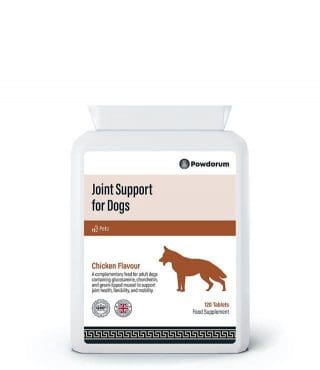
Powdorum Pet Joint Support
Glucosamine, chondroitin, and MSM combined in one chicken-flavoured tablet — formulated for dogs and cats, with a weight-based dosing guide on the label. No filler ingredients. Available in two sizes.
Pet Joint Support
120 Tablets
A 30–60 day supply depending on your dog’s weight. The right starting point to assess how your dog responds before committing to a larger pack. Chicken-flavoured, suitable for all breeds.
Chondroitin
MSM
Chicken flavour
All breeds
Pet Joint Support
300 Tablets
A 75–150 day supply depending on your dog’s weight. Joint supplements work through cumulative use — this is the more cost-effective option for ongoing senior dog support and owners already seeing results.
Chondroitin
MSM
Chicken flavour
All breeds
Prefer a powder? The same active formula is also available in powder form — ideal for dogs who refuse tablets or for mixing directly into wet food. Browse the full pet supplement range at Powdorum.
What the Research Actually Says
The evidence base for glucosamine and chondroitin in dogs is broadly positive, though not uniform. A randomised, double-blind, positive-controlled trial involving 35 dogs with confirmed hip or elbow osteoarthritis found that glucosamine and chondroitin produced statistically significant improvements in pain scores and weight-bearing by day 70 — with a prescription NSAID used as the positive control. The supplement group improved meaningfully, just more slowly.
That slower onset is important context for owners: if your senior dog isn’t showing improvement in week two, that is not failure — it’s how these compounds work. The same clinical review also notes that glucosamine and chondroitin appear to have a joint-protective effect even before symptoms develop, which explains why starting large breeds early is consistently recommended. Source: DVM360
For dogs already on prescription pain medication, the PDSA notes that joint supplements are generally safe alongside common arthritis medicines — but confirm with your vet first, particularly for dogs on anticoagulants or with diabetes.
When Supplements Aren’t Enough
Joint supplements are not a replacement for veterinary care. There are situations where they alone won’t be sufficient:
- Moderate-to-severe osteoarthritis causing significant daily pain or lameness
- Acute joint injury — ligament tears, fractures, or sudden-onset lameness require vet diagnosis
- Rapid deterioration in mobility over days or weeks rather than the gradual change typical of age-related wear
- End-stage bone-on-bone joint disease where cartilage has been largely lost
In these cases, prescription anti-inflammatories, pain management, physiotherapy, or surgical options may be needed first or alongside supplementation. For a broader overview of when and why dogs benefit from different types of supplements, see our guide to do dogs need supplements. For a full comparison of joint supplement ingredients and what to look for, see joint supplements for dogs. For weight, exercise and daily habits at every life stage, see our joint care for dogs guide.
Frequently Asked Questions
The best joint supplements for senior dogs in the UK contain glucosamine sulphate, chondroitin sulphate, and MSM at adequate doses — typically 500mg or more of glucosamine per daily serving for a medium-to-large dog. Adding omega-3 fatty acids is recommended for dogs already showing arthritis signs. Always check milligram amounts on the label. Powdorum’s Pet Joint Support combines all three core ingredients in a chicken-flavoured tablet, available in 120 and 300 count formats, with weight-based dosing guidance on the label.
For large and giant breeds — Labradors, German Shepherds, Golden Retrievers, Rottweilers, Great Danes — most vets recommend starting preventive joint support from around 2–3 years, well before symptoms appear. For small and medium breeds, starting at 5–7 years is more typical. The earlier you start, the more you are supporting cartilage that is still intact rather than trying to slow damage that has already occurred.
In most cases yes. Glucosamine and chondroitin are generally safe alongside common veterinary medications including NSAIDs such as meloxicam or carprofen. However, dogs on anticoagulants should not take chondroitin without veterinary guidance, and dogs with diabetes should be monitored when starting glucosamine. The PDSA confirms joint supplements are generally safe alongside standard arthritis medications — but always check with your vet first.
Most owners notice a difference in mobility and willingness to exercise within 4–8 weeks of consistent daily supplementation. Clinical research shows statistically significant improvements in pain scores by day 70. Cartilage-supporting ingredients work through slow, cumulative processes — give the supplement at least 6–8 weeks before assessing whether it is working. If there is no change after 10 weeks, revisit with your vet.
For mild early-stage arthritis, well-formulated supplements can be a meaningful first line of support alongside weight management and controlled exercise. For moderate-to-severe arthritis, supplements work best as part of a vet-directed plan that may include prescription treatment. Browse the Powdorum pet supplement range for available support options.
Disclaimer: This article is for informational purposes only and does not constitute veterinary advice. Supplements are not medicines and are not intended to diagnose, treat, cure, or prevent any condition in animals. If your dog is showing signs of joint pain, lameness, or significant changes in mobility, consult a vet before starting any supplement. Individual responses vary. Always follow dosage guidance on the product label.